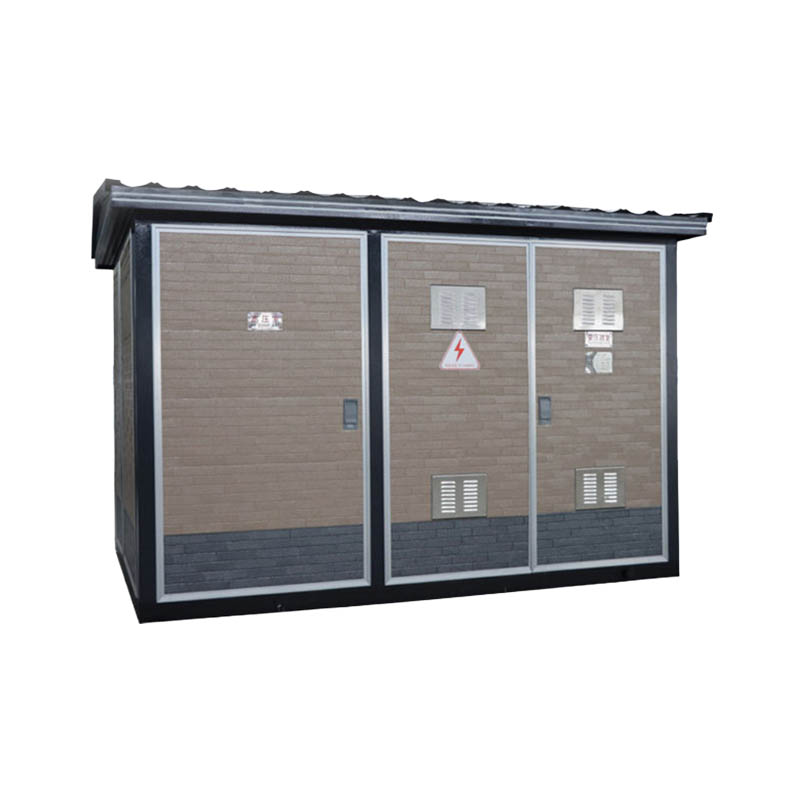
Land Scarcity and Long Construction Cycles? How Compact Substations Offer a Solution
Publish Time: 2025-10-22
With the rapid pace of urbanization and increasing pressure on land resources, the limitations of traditional substations—such as large land requirements and long construction cycles—have become increasingly evident. Compact substations represent an innovative solution in power infrastructure, offering a unique design concept and significant advantages. They not only effectively address the challenges of limited land availability but also reduce construction costs and shorten project timelines while ensuring safe and reliable power supply. As such, compact substations provide strong support for the sustainable development of urban areas.Composition of the Compact Distribution UnitThe core of a compact substation lies in its compact distribution unit, which is composed of several key components: high-voltage switchgear, transformers, low-voltage switchgear, energy metering devices, and reactive power compensation units. These components are not merely assembled together; they are carefully designed and optimized, integrated into one or more cabinets to form a cohesive system.The high-voltage switchgear serves as the "gatekeeper" of the power system, responsible for controlling and protecting high-voltage circuits to ensure safe and stable power transmission under all operating conditions. Transformers are critical for voltage conversion, transforming high-voltage electricity into low-voltage power suitable for end users, meeting the requirements of various electrical devices. Low-voltage switchgear further distributes and controls the low-voltage circuits, ensuring proper operation of each load circuit. Energy metering devices provide precise measurement of electricity consumption, supporting accurate billing and management. Reactive power compensation units regulate the system’s reactive power, improving power factor, reducing line losses, and enhancing overall operational efficiency. This integrated design ensures close interconnection between components and rapid signal transmission, thereby enhancing the reliability and stability of the entire distribution unit.Configuration Types and CharacteristicsCompact distribution units are available in “M” type and “P” type configurations to meet diverse user requirements and application scenarios. The “M” type prioritizes comprehensive functionality and flexibility, making it suitable for locations with high power demands and complex electrical systems, such as large commercial complexes and industrial parks. It offers extensive interfaces and expansion options, allowing users to customize and upgrade according to actual needs.The “P” type emphasizes economy and practicality, tailored for locations with simpler power requirements and smaller electrical loads, such as small commercial shops and residential communities. Its streamlined design and lower cost provide reliable power supply without unnecessary complexity.Beyond configuration diversity, compact distribution units feature a range of notable advantages. Their fully integrated design consolidates multiple electrical devices into one or more cabinets, reducing interconnecting wiring and minimizing the footprint, thereby maximizing space utilization. The short installation cycle is another key benefit; standardized design and modular assembly allow for rapid on-site installation and commissioning, significantly reducing construction time. Additionally, compact substations offer reliable and safe operation, as all components undergo rigorous testing and matching to prevent power outages due to equipment failure or connection issues. Compared to traditional substations, compact substations also provide clear investment benefits, with lower construction and maintenance costs, saving users significant capital.Cabinet Material OptionsThe cabinet serves not only as protective housing for the internal equipment but also affects the appearance and service life of the distribution unit. To meet various user requirements and environmental conditions, cabinets can be made from decorative panels, cold-rolled steel, or stainless steel.Decorative panel cabinets feature unique aesthetic effects, with surfaces that can be engraved with patterns and designs, adding an artistic touch. Such cabinets are suitable for locations with high aesthetic standards, such as substations in city centers, allowing them to blend seamlessly with surrounding architecture and enhance the urban landscape. Cold-rolled steel cabinets offer high strength and rigidity, capable of withstanding external impacts and pressure to protect internal equipment. Treated surfaces provide good corrosion resistance, making them suitable for general industrial and commercial environments. Stainless steel cabinets are favored for their excellent corrosion resistance and attractive appearance, capable of long-term operation in harsh environments without rusting. They are ideal for coastal areas, chemical plants, and other locations with high corrosion requirements. Users can select the appropriate cabinet material based on their specific needs and budget to achieve optimal performance.Transformer Capacity and Low-Voltage Outgoing CircuitsTransformers are a core component of compact substations, with capacities ranging from 100 kVA to 2500 kVA to meet the electricity needs of users of varying scales. For small users, such as small commercial shops or residential communities, transformers in the 100–315 kVA range generally suffice for daily power consumption. Larger industrial users or commercial complexes require higher-capacity transformers, such as 800 kVA or above, to ensure sufficient and stable power supply.Low-voltage outgoing circuits are also carefully planned according to transformer capacity. Typically, transformers ≤315 kVA support 4–6 low-voltage outgoing circuits; transformers 400–630 kVA support 6–8 circuits; transformers ≥800 kVA support 8–12 circuits. This design ensures adequate power supply for varying numbers of electrical devices, prevents overloading, and avoids wasted resources. By appropriately selecting transformer capacities and planning low-voltage circuits, compact substations achieve efficient allocation of electrical resources, providing high-quality and reliable power service.